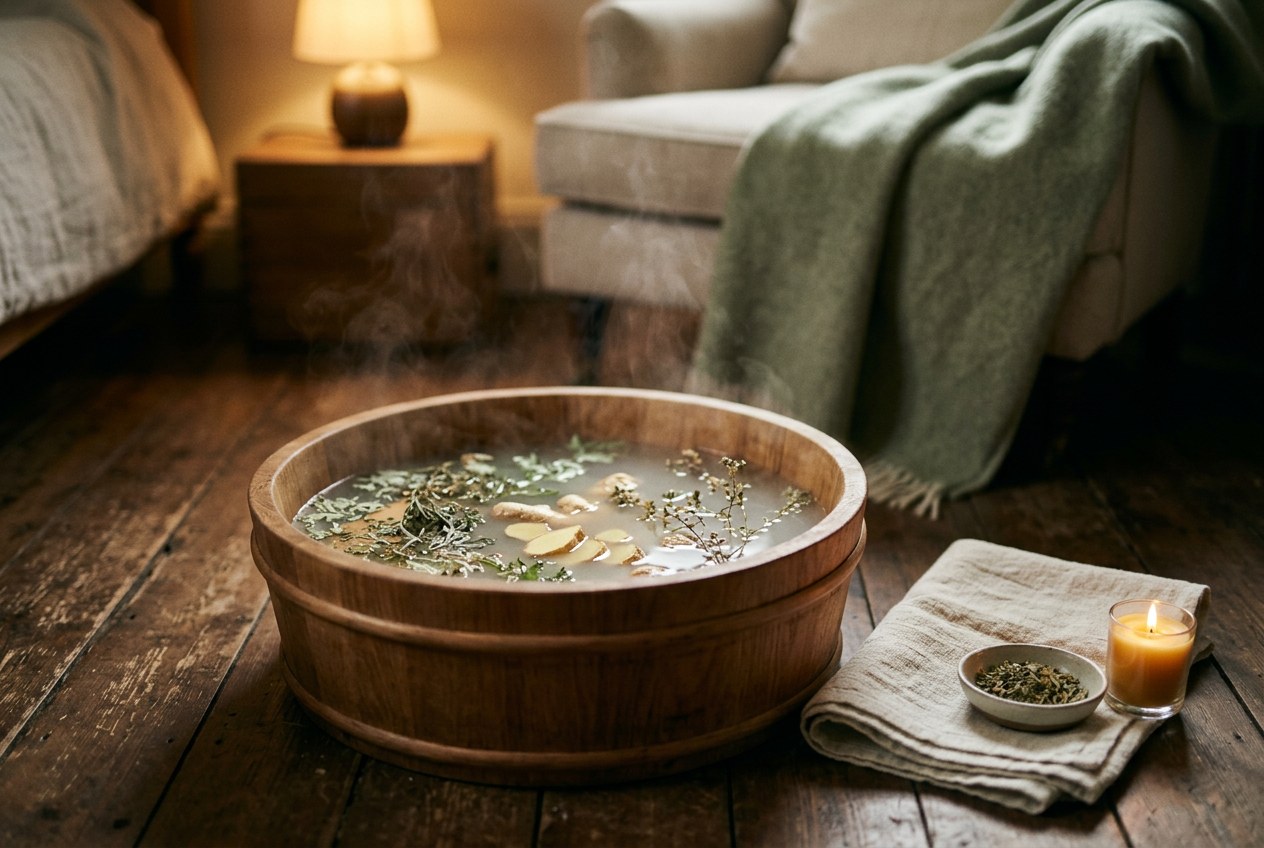
It is late, the house is finally quiet, and your feet are cold under the blankets no matter how long you lie there. You scrolled too long, your shoulders are still up by your ears, and sleep feels a step too far away. Across many homes in Richmond, this is the moment a kettle goes on, not for tea, but for a basin of warm water by the bed. The foot soak TCM ritual is one of the oldest, simplest wind-down habits in Chinese culture, and it asks almost nothing except ten quiet minutes.
Why does a warm foot soak help you wind down at night?
A warm foot soak helps you wind down because it draws energy and attention downward, away from a busy head and toward the feet, which Traditional Chinese Medicine sees as a gateway to rest. In TCM terms, warmth at the feet encourages qi and blood (气血) to circulate to the body’s lower reaches, easing the “tired but wired” feeling of a mind that will not switch off.
There is a plainer layer too. Your feet are far from the heart and quick to feel cold, especially in a damp coastal climate. Gently warming them widens the small vessels there, and that signal of warmth and safety tells your nervous system the day is over. The sole also carries a point TCM values for grounding and calm, Yongquan (涌泉), roughly in the hollow of the front-center of the foot. You do not need to find it precisely; the warm water reaches the whole area. That is the point of the foot soak TCM tradition: a small, repeatable nudge toward rest, not a medical procedure.
What water temperature and timing should you use?
Keep the water comfortably warm, about 38 to 43°C, and soak for only 10 to 20 minutes, ideally 30 to 60 minutes before bed. Hotter and longer is not better; the aim is a gentle, settling warmth, not a sweat-it-out session.
A few simple guidelines make the ritual both pleasant and safe:
| Element | Sensible range | Why it matters |
|---|---|---|
| Temperature | ~38–43°C, warm not hot | Too hot reddens skin, raises the heart rate, and over-stimulates rather than calms |
| Duration | 10–20 minutes | Long soaks can leave you light-headed or drained instead of relaxed |
| Water level | Ankle to mid-calf | Covers the feet and lower legs where warmth does the most good |
| Timing | 30–60 min before bed | Lets the body cool gently afterward, which itself cues sleep |
| Stop signal | A faint warmth or light back sweat | Heavy sweating means you have overdone it; wrap up and rest |
Always test the water with your wrist or elbow first, not your toes, since feet judge heat poorly. Towel off, put on warm socks, and head to bed while the cozy feeling lasts. If you feel dizzy, breathless, or your heart races, stop, get out, and sit down.
What simple herbs can you add to a foot soak TCM recipe?
The two most common and gentle additions are mugwort (艾叶) and fresh ginger (姜), both used in TCM to warm and move, and both easy to find in Richmond’s Chinese grocers and herbal shops. You do not need a complicated recipe; a small handful, simmered and poured in, is enough.
Two starter recipes most people can make tonight:
- Mugwort soak (warming, calming): Simmer a small handful of dried mugwort in 1 to 1.5 litres of water for 10 minutes, then add it to your basin and top up to a comfortable level. Mugwort (艾叶) is traditionally used to warm the channels, a familiar friend to cold feet and a restless evening.
- Ginger soak (for cold, damp feeling): Smash 4 to 6 slices of fresh ginger and simmer the same way. Ginger (姜) is warming and dispersing, a common choice when you feel chilled or heavy, especially in Vancouver’s long rainy stretches.
A few sensible rules with herbs: start small, use a soak only a few nights a week rather than every night, never drink the water, and rinse the basin afterward. If your skin turns red, itchy, or irritated, stop and switch back to plain warm water. These soaks are everyday comfort, not medicine, and they are not a treatment for any condition.
If heaviness, brain fog, and cold-damp feelings are a running theme for you, especially in the wet months, our guide to the damp Vancouver season explains the pattern and the diet and lifestyle steps that pair well with a warming soak.
Who should be careful with foot soaks?
Some people should keep foot soaks cooler, shorter, and herb-free, or skip them altogether, because warmth and submersion carry real risks for certain bodies. It is gentle for most, but not for everyone.
Be cautious, and check with a doctor or registered TCM practitioner first, if any of these apply:
- Diabetes or nerve damage (neuropathy): Reduced foot sensation means you can scald yourself without feeling it. Keep water clearly cooler, limit time, inspect your feet afterward, and have someone else check the temperature.
- Varicose veins or known circulation problems: Heat can worsen pooling and discomfort in the legs. Keep it brief and only lukewarm, or ask your practitioner first.
- Pregnancy: Avoid hot water and long soaks, and skip strong or warming herbs like mugwort unless a registered TCM practitioner has cleared them for you. Comfortably warm and short is the rule.
- Open sores, cuts, athlete’s foot, or skin infections: Soaking can spread infection or slow healing. Wait until the skin is intact.
- Heart conditions, very high or low blood pressure, or feeling unwell: Warmth shifts blood flow and can make you light-headed. Go shorter and cooler, or skip it.
- Right after a big meal or alcohol: Give it some time; soaking can leave you flushed and woozy.
None of this means a foot soak is dangerous. It means a little judgment keeps a pleasant habit safe. When in doubt, plain warm water for a short time is the cautious default, and a professional can tell you what suits you.
How does a foot soak fit a wider wellness routine?
A foot soak is best treated as one calming brick in a larger wall, not the whole answer to fatigue, cold feet, or poor sleep. It pairs naturally with an early screen cut-off, slow breathing, and a steady bedtime.
If you often feel cold, tired, or heavy and a nightly soak only takes the edge off, that is worth a closer look. Persistent cold feet, swelling, or exhaustion can reflect a pattern a registered TCM practitioner (R.Ac) would want to assess properly, rather than something to soak away alone. For evenings when even sitting still feels hard, some clients use our gentle Energy Activation Pod in Richmond to wind down alongside other care. And if you are weighing a full assessment, our overview of TCM in Richmond walks through what that looks like.
Start tonight with the simplest version: warm water, ten minutes, warm socks, lights low. Notice how your feet and shoulders feel afterward. Good wellness is rarely one dramatic fix; it is small, kind habits repeated until your body learns it is safe to rest.
Want a routine that fits your body? A warm foot soak is a lovely start, but if cold feet, fatigue, or restless nights keep returning, a registered TCM practitioner can assess the pattern behind them and build a plan that fits your life. Book with Dr. Judy Chu, R.Ac at Sky TCM Acupuncture & Wellness, 3779 Sexsmith Rd, Unit 1138, Richmond, BC (Continental Centre). Call 778-681-8886 to take the next step toward warmer, calmer evenings.