It’s late afternoon in an Continental Centre office tower in Richmond, and three people on the same floor are reaching for very different cups. One has a tension headache and a tight chest after back-to-back meetings. Another is squinting at a screen with dry, hot eyes. The third feels foggy and bloated after lunch and just wants to feel light again. They could all grab the same generic teabag — but TCM would hand each of them a different cup. Choosing a wellness tea by constitution means the right brew depends on your body type, not on what’s trending.
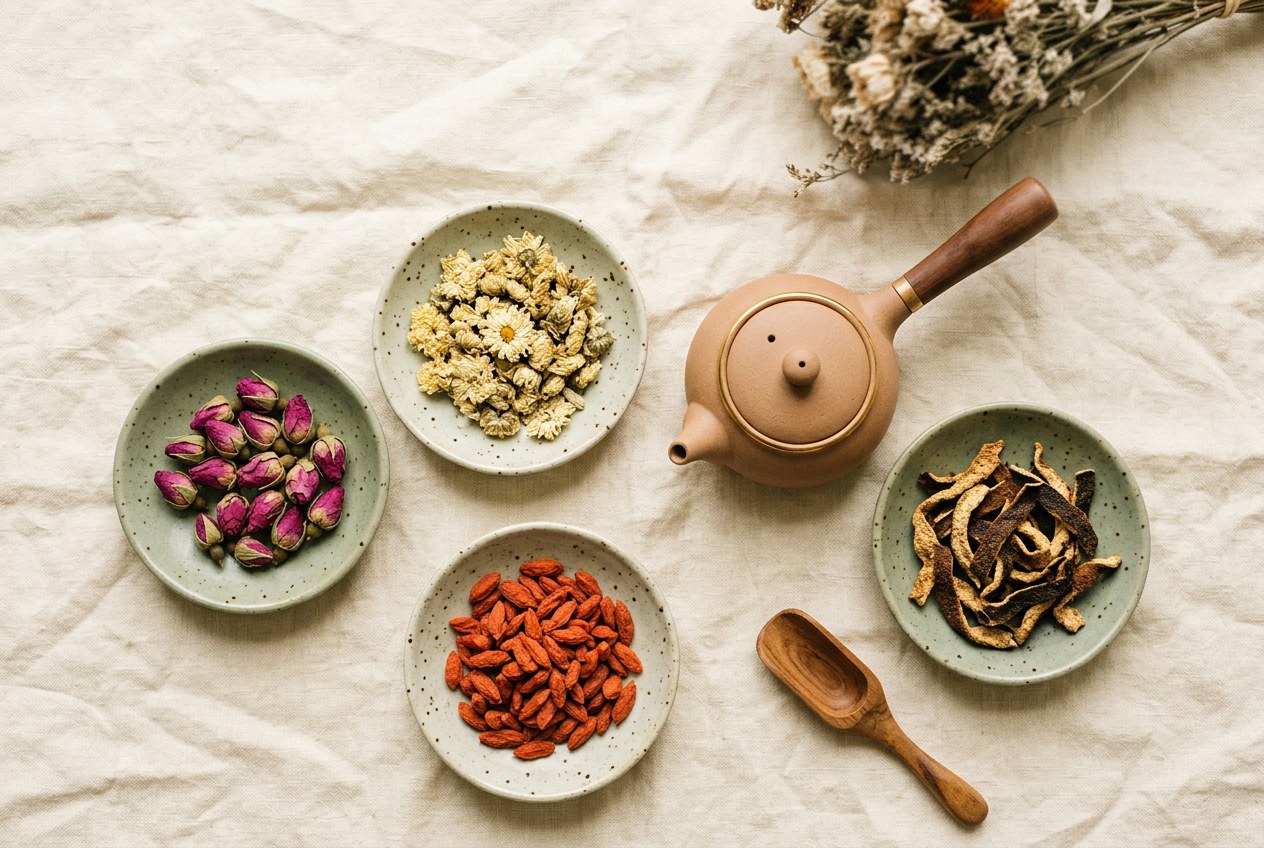
Matching a tea to your constitution is one of the oldest, gentlest forms of Chinese food therapy (食疗 shi liao). You don’t need a cabinet of exotic herbs. Four everyday ingredients cover most of what busy people in Vancouver and Richmond run into.
What does “wellness tea by constitution” actually mean?
A wellness tea by constitution is simply a herbal brew chosen to balance your particular body type, rather than a one-size-fits-all drink. In TCM, constitution (体质 ti zhi) describes your baseline tendencies: some people run warm and dry, others cold and damp, some hold tension, others tire easily. The same tea that soothes one person can feel wrong for another.
That’s why the goal isn’t to find the single “best” tea. It’s to read your own signals, then pick a brew that nudges you back toward balance. Think of it as seasoning your day — gently warming, gently cooling, gently moving, depending on what your body is asking for.
Which four wellness teas match which body types?
For most everyday concerns, four classic single-herb teas cover the bases. Here’s how they map to common patterns.
| Tea | TCM action | Best when you feel | A good time to drink | Go easy if |
|---|---|---|---|---|
| Rose bud (玫瑰花 mei gui hua) | Soothes liver qi, eases stagnation | Stressed, irritable, tight chest, PMS tension | Mid-afternoon slump or before a stressful task | Pregnant; very loose stools |
| Chrysanthemum (菊花 ju hua) | Clears heat, brightens the eyes | Hot, flushed, red or tired eyes, screen strain | Hot days, long screen sessions | You run cold; loose stools; pregnancy (use caution) |
| Goji berry (枸杞 gou qi zi) | Tonifies, nourishes blood, supports eyes | Tired, dry, run-down, dry eyes | Morning or as a daytime sip | You’re fighting a cold or feel feverish |
| Chenpi / dried tangerine peel (陈皮 chen pi) | Strengthens the spleen, moves qi, dries damp | Bloated, heavy, sluggish digestion, phlegmy | After a heavy or greasy meal | You feel very dry or thirsty |
A practical way to start: brew one herb at a time so you learn how each makes you feel. A small pinch in hot water, steeped a few minutes, is plenty. Many people find goji and chenpi pleasant daily, while rose and chrysanthemum work better as “when I need it” cups.
Why rose tea for stress, and chrysanthemum for heat?
Rose soothes and chrysanthemum cools — that difference comes straight from how TCM reads your symptoms. When stress builds, TCM describes it as liver qi getting “stuck,” showing up as a tight chest, short temper, sighing, or premenstrual tension. Rose bud is the gentle classic here because it’s seen as helping that stagnant qi move again. If this pattern sounds familiar, our deeper look at liver qi stagnation and stress walks through it in more detail.
Chrysanthemum sits on the opposite end. It’s a cooling herb, used when there’s “heat” — a flushed face, irritated or tired eyes, the dry-screen feeling after a long workday. On Vancouver’s rare hot days, or during back-to-back video calls, a light chrysanthemum tea can feel like opening a window.
The takeaway: don’t reach for chrysanthemum if you already run cold and crave warmth, and don’t lean on rose if your real issue is heat. Reading the pattern matters more than the herb’s reputation.
How do goji and chenpi support energy and digestion?
Goji nourishes when you’re depleted; chenpi lightens you when you feel heavy. They do two different jobs. Goji berries (gou qi zi) are a tonifying food, traditionally used to support the liver, kidneys, and eyes. They suit the “run-down and dry” feeling — low energy, dry eyes, that end-of-quarter wrung-out state. You can steep them, or just drop a small handful into warm water and eat them after.
Chenpi, dried tangerine peel, is the digestion helper. TCM sees it as strengthening the spleen-stomach (脾胃 pi wei), the system in charge of turning food into usable qi and blood. When you feel bloated, heavy, or phlegmy after rich meals, a chenpi brew is the classic gentle nudge. It pairs naturally with the idea that warm, unhurried eating supports your middle.
If you like keeping these herbs close, some people enjoy aromatic herbal bead bracelets as a daily reminder to slow down — a small ritual that pairs nicely with a mindful cup.
How do I find out my constitution?
The fastest start is a structured constitution quiz, then a clinic check if you want to go deeper. Self-observation gets you surprisingly far: notice whether you run hot or cold, dry or damp, tense or tired, and which tea above matches. To make this more concrete, our TCM constitution quiz helps you spot your dominant pattern in a few minutes.
That said, many people are a mix — warm but tired, damp but tense — and a quiz can only go so far. A registered TCM practitioner reads your pulse and tongue, asks about sleep, digestion, and cycle, and can tell you which teas truly fit and which to skip. That’s the difference between guessing and a plan built for your body.
A few sensible cautions
Herbal teas are gentle, but gentle is not the same as risk-free. Keep these in mind:
- Pregnancy and breastfeeding: several common herbs, including rose and chrysanthemum, are used cautiously or avoided. Check first.
- Medications and chronic conditions: if you take regular medication or manage a health condition, confirm herbs are compatible before making them a daily habit.
- Listen to your body: loose stools, a chill, or feeling worse are signs a tea doesn’t suit you. Switch or stop.
- Tea is support, not treatment: persistent stress, fatigue, eye problems, or digestive issues deserve a proper assessment, not just a new cup.
Ready to find the tea, and the plan, that fits you?
If you’d like to know your constitution and which wellness tea by constitution actually suits your body, a TCM assessment is the clearest next step. At Sky TCM Acupuncture & Wellness in Richmond — a short walk from Continental Centre — Dr. Judy Chu, R.Ac reviews your body type and builds gentle food-therapy and herbal suggestions around it, no guesswork. Visit us at 3779 Sexsmith Rd, Unit 1138, Richmond, BC, or call 778-681-8886 to book. Curious which everyday TCM care fits Richmond life? See our overview of TCM in Richmond.