Energy Acupuncture Sounds Vague — So Let Me Take It Apart
You’re waiting out a red light on No. 3 Road, and you roll one shoulder. That’s when you notice it’s been up around your ear since roughly nine this morning.
It isn’t that you aren’t tired. It’s that you’ve been tired long enough to have lost the knack of putting it down.
Why bodies end up locked like that is the subject of The Metro Vancouver Clench: You Know How to Rest — You Just Can’t Stop. This article is about one thing only: what we’ve put together for that state.
It’s called energy acupuncture. Everyone knows the acupuncture half. It’s the word energy that makes people narrow their eyes — and narrowing your eyes is the correct response. Anything that sounds vague deserves the question “so what is it, specifically?”
So here is the article, split down the middle: which half is a regulated clinical procedure, and which half is simply there to make you more comfortable.
【Image: COVER header】
What is energy acupuncture, exactly?
Let’s settle one thing first: it is not a newly invented needling technique.
It’s a combined session. Traditional acupuncture comes first, working the meridians and supporting the movement of Qi and blood. A period of guided energy work follows, so the session as a whole runs quieter and more comfortably.
The acupuncture is performed by a registered acupuncturist (R.Ac) in British Columbia and follows ordinary TCM assessment: your constitution, where your body is leaning that day, and only then the point selection. This is the substance of the appointment. Everything clinical lives in this half.
The energy work handles the experience layer: a quiet room, unhurried guidance, and enough time for the body to come down off its guard.
Isn’t “energy” a bit of a stretch?
In North America, the word energy drags a fair amount of unverifiable baggage behind it. Being sceptical about that is healthy.
So let me be blunt, to avoid any misunderstanding. Energy work here is a relaxation component of the session. It is not used to diagnose. It is not used to treat disease. It does not replace medical care of any kind. The assessment and the needling are always the practitioner’s work.
Not interested in that layer? You’re welcome to book the acupuncture on its own.
As for how any of it lands on the day — how pronounced the needle sensation is, whether the body feels warm, how far you actually unwind — that varies from person to person, and from day to day for the same person. We adjust the arrangement to suit you.
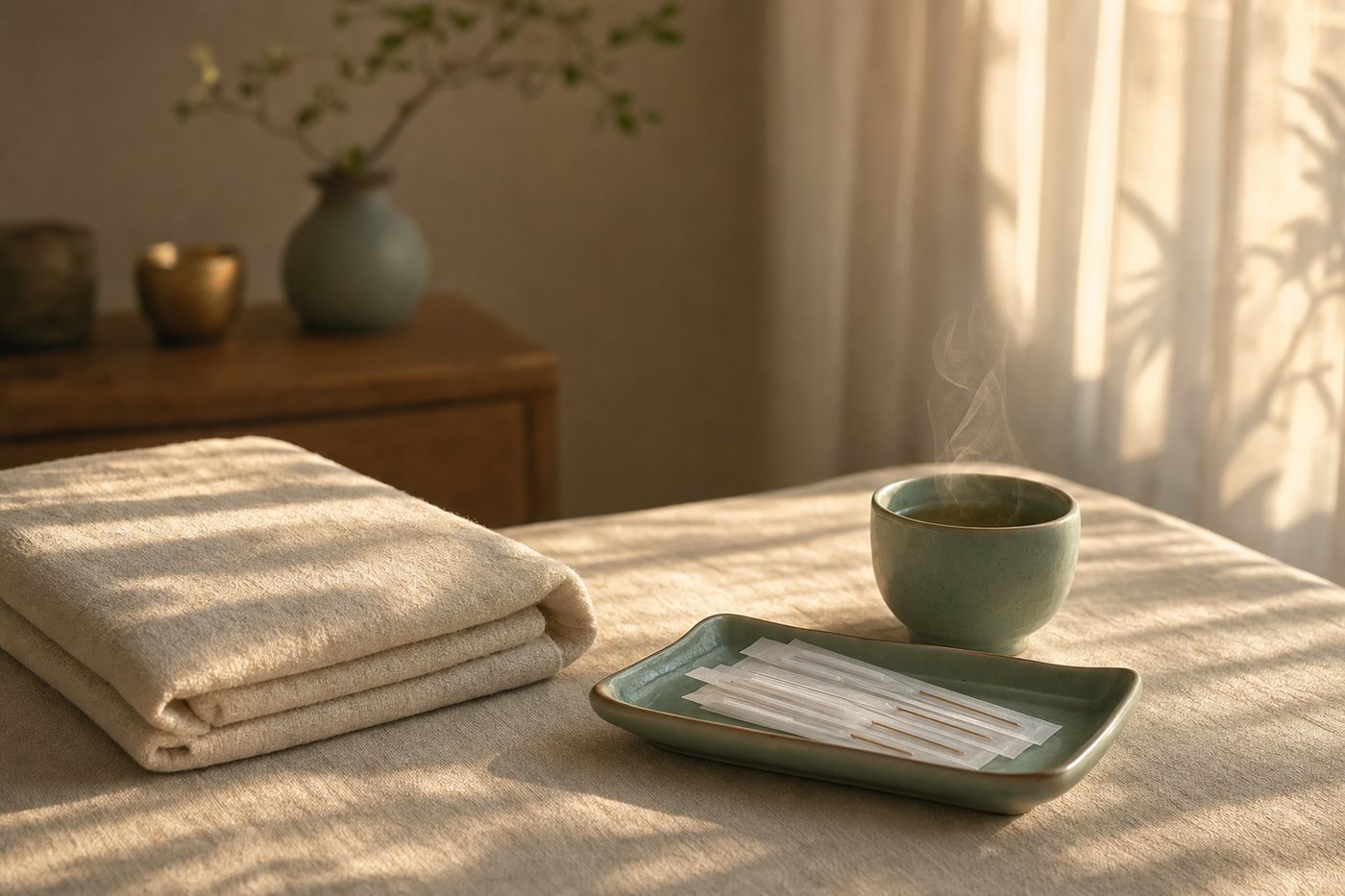
【Image: ROOM treatment room】
How is it different from a standard acupuncture session?
Nothing stronger has been added. Relaxation has simply been moved out of the giveaway column and into the plan.
The pacing is different. A standard appointment is often built around efficiency: in, needles, retention, needles out, back to your day. Energy acupuncture treats the retention phase as the part worth scheduling around.
The room is different. Light, sound, and the pace of your own breathing each get a deliberate pass.
The ending is different. Nobody hurries you upright. You get a few minutes to come back before you sit up.
Why arrange it that way? Because when a body has been braced for months, rest doesn’t simply happen on request. TCM has long held that Qi and blood do well when they move and badly when they stall, and a braced body isn’t especially willing to open. The retention phase, meanwhile, is already one of the few genuinely blank stretches in the day.
But reading this as a premium tier sitting above a basic one gets it wrong. Some situations are better served by brisk, direct needling. Which one suits you is decided together at the intake.
We haven’t made relaxation arrive faster. We’ve just stopped saving it for the end.

What does one session actually look like?
1. Sitting down to talk. Intake, tongue, pulse. Sleep, appetite, mood, your cycle, and whatever you’re currently taking. This step determines everything that follows it.
2. The plan, out loud. Your practitioner explains what they intend to do and roughly what you’re likely to feel. You change into loose clothing and find a position you can hold comfortably without moving.
3. Needles in, needles stay in. The needles are very fine. The sensation usually turns up as a dull ache, fullness, heaviness or tingling — a different thing entirely from the pain of skin being cut. During the retention phase there is nothing you need to do. If at any point you feel dizzy, notice your heart racing, break into a cold sweat, feel nauseated, or your vision starts to grey out, say so immediately — don’t tough it out. Once you’ve said it, it gets handled on the spot.
4. Guided relaxation. The lights come down and the room goes quiet. Your practitioner talks you through a few rounds of lengthening the exhale, so the shoulders and jaw let go first, then leaves you undisturbed until the needles come out. You are awake throughout and can stop at any point. Sleep if you want to. Stare at the ceiling if you want to.
This stretch does exactly one thing: it helps you relax. It does not diagnose, it is not aimed at any condition, and it carries no treatment function.
5. Needles out, and a proper close. The points get checked, you get aftercare for the next few days, and we ask how the session went for you — which informs the next one.
The whole thing needs a stretch of time you’re not in a hurry to leave. Length and arrangement — please confirm with us when you book.
Never had needles before? The full walkthrough is in What Actually Happens at Your First Acupuncture Appointment.
Who is this worth a phone call about?
You don’t need a diagnosis to be worth talking to.
Shoulders and a neck that stay tight no matter how many massages you book, and go straight back the day after. An hour of lying there before sleep arrives, then waking as though you never went under. Nothing much actually wrong, and still running on standby all day. All of it counts.
What’s going on underneath is in The Metro Vancouver Clench. Not sure whether you count? Call and ask before booking anything: 778-681-8886.
One line does need drawing clearly, though. Sudden severe pain, a fever that won’t break, chest tightness or palpitations, discomfort following an injury, or symptoms that get worse day over day — see your family doctor, go to a walk-in clinic or the emergency department first, and call 911 if the situation calls for it. TCM is a complement to everyday care. It is not a substitute in an emergency.
【Image: REST quiet moment】

Before you come, after you leave
Before:
- Don’t arrive hungry, and don’t arrive having just eaten a large meal
- Wear loose clothing, with sleeves and trouser legs that roll up easily
- Skip alcohol that day
- Tell your practitioner about your medications, supplements and health conditions — anticoagulants especially
- Leave yourself a window you’re not rushing out of
After:
- Have some warm water, and take the rest of the day at a slower pace
- Skip intense exercise, cold water, and long stretches in wind or air conditioning that day
- Keep the points clean and dry, and don’t rub them
- A small bruise or a brief stretch of tiredness is possible and usually settles on its own; if a bruise keeps growing or the soreness gets worse, call the clinic
Who has to speak up first?
Acupuncture is an invasive procedure. In British Columbia it must be performed by a registered acupuncturist (R.Ac), using single-use sterile needles. Please raise the following on your own initiative when you book and again at the intake, so your practitioner can decide whether it suits you and how to proceed:
- Pregnancy, or trying to conceive
- A bleeding disorder, or taking anticoagulant or antiplatelet medication
- Infection, broken skin, eczema or severe allergy at the treatment site
- An implanted electronic device such as a pacemaker
- The arm or leg on a side where lymph nodes have been removed
- Diabetes with slow-healing wounds, a weakened immune system, or ongoing treatment affecting it
- A current fever, or an active acute infection
- A history of fainting during needling or at the sight of blood
Not sure whether something counts? Say it anyway. Deciding what matters is your practitioner’s job, not yours.

Common Questions
Q1: Is energy acupuncture a new needling technique?
No. The acupuncture is traditional acupuncture, performed by a registered acupuncturist (R.Ac) in British Columbia. “Energy acupuncture” is simply the name for a session that combines that acupuncture with a guided relaxation phase of energy work.
Q2: Do the needles hurt?
The needles are extremely fine. What you notice is usually a dull ache, fullness, heaviness or tingling — a different thing from the pain of skin being cut. Sensitivity varies a great deal from person to person, and noticing very little is normal too. If anything feels uncomfortable, say so at the time and your practitioner will adjust.
Q3: How many sessions does it take to work?
We don’t give “just a few sessions and you’re set” answers — that would be neither responsible nor consistent with professional practice standards here. Every situation and every pace is different, and the pace is something worked out together after the intake.
Q4: I’m sceptical about anything described as energy. Can I still come?
Of course. We’re clear about what energy work is here: a relaxation component of the session experience. It does not diagnose, does not treat disease, and does not replace any medical care. You’re also welcome to book the acupuncture on its own.
Q5: I’m pregnant, or on medication. Can I have this?
Please tell us when you book. Pregnancy, trying to conceive, anticoagulant medication, skin infection or broken skin, an implanted device such as a pacemaker, and past lymph node removal all need an in-person assessment before we decide whether it suits you and how to arrange it.
【Image: CORNER clinic corner】
From Dr. Judy
Twenty years of clinical practice in Taiwan taught me something slowly. A lot of people walk into a treatment room for more than one symptom. They come because they would like half an hour in which nothing is required of them.
I’m not going to tell you that you’ll walk back out a different person. What I can tell you is that for that stretch of time, your body gets taken seriously and your questions get answered properly.
Want to know whether it suits you?
That depends on your constitution, on where your body is right now, and on whatever else you’re dealing with — none of which can be settled before an in-person assessment.
Sky TCM Acupuncture & Wellness
Continental Centre, Richmond
3779 Sexsmith Rd, Unit 1138, Richmond, BC V6X 3Y6
Phone 778-681-8886 — session content, length and available appointment times are things we’ll confirm together on the phone.
Acupuncture is performed by Dr. Judy Chu, R.Ac — a registered acupuncturist in British Columbia, with twenty years of clinical practice in Taiwan — following assessment.
Further reading
- What Actually Happens at Your First Acupuncture Appointment — the whole visit, front door to sidewalk
- The Metro Vancouver Clench: You Know How to Rest — You Just Can’t Stop — tight shoulders, poor sleep, and never quite switching off
This article is general health education. It is not medical advice and does not replace diagnosis or treatment by a physician. Acupuncture is an invasive procedure and must be assessed and performed by a registered acupuncturist (R.Ac) in British Columbia. If you are pregnant, have a bleeding disorder, take anticoagulant medication, or have a skin infection, please tell your practitioner before treatment. For urgent or serious conditions, seek medical care directly or call 911.