What Actually Happens at Your First Acupuncture Appointment
“You really should try acupuncture.” That’s the third time a friend has said it, isn’t it?
It isn’t that you don’t want to. It’s that the word needle shows up and the back of your neck tightens on its own.
Ask around and you get two answers, always. Half the people say they barely felt a thing. The other half tell a story that makes you want to cancel a booking you haven’t even made. So which half is telling the truth?
【Image: COVER header】
It isn’t the needle you’re afraid of. It’s not knowing what comes next.
This isn’t a pep talk. It’s a walkthrough of a first acupuncture appointment from the front door to the sidewalk. Read it, then decide for yourself.
The needle you’re picturing isn’t the needle a TCM practitioner uses
The needle in your head is almost certainly a hypodermic — the kind used for blood draws and vaccines. Bevelled tip, hollow shaft, built to draw out or push in. Its whole job is to cut a path.
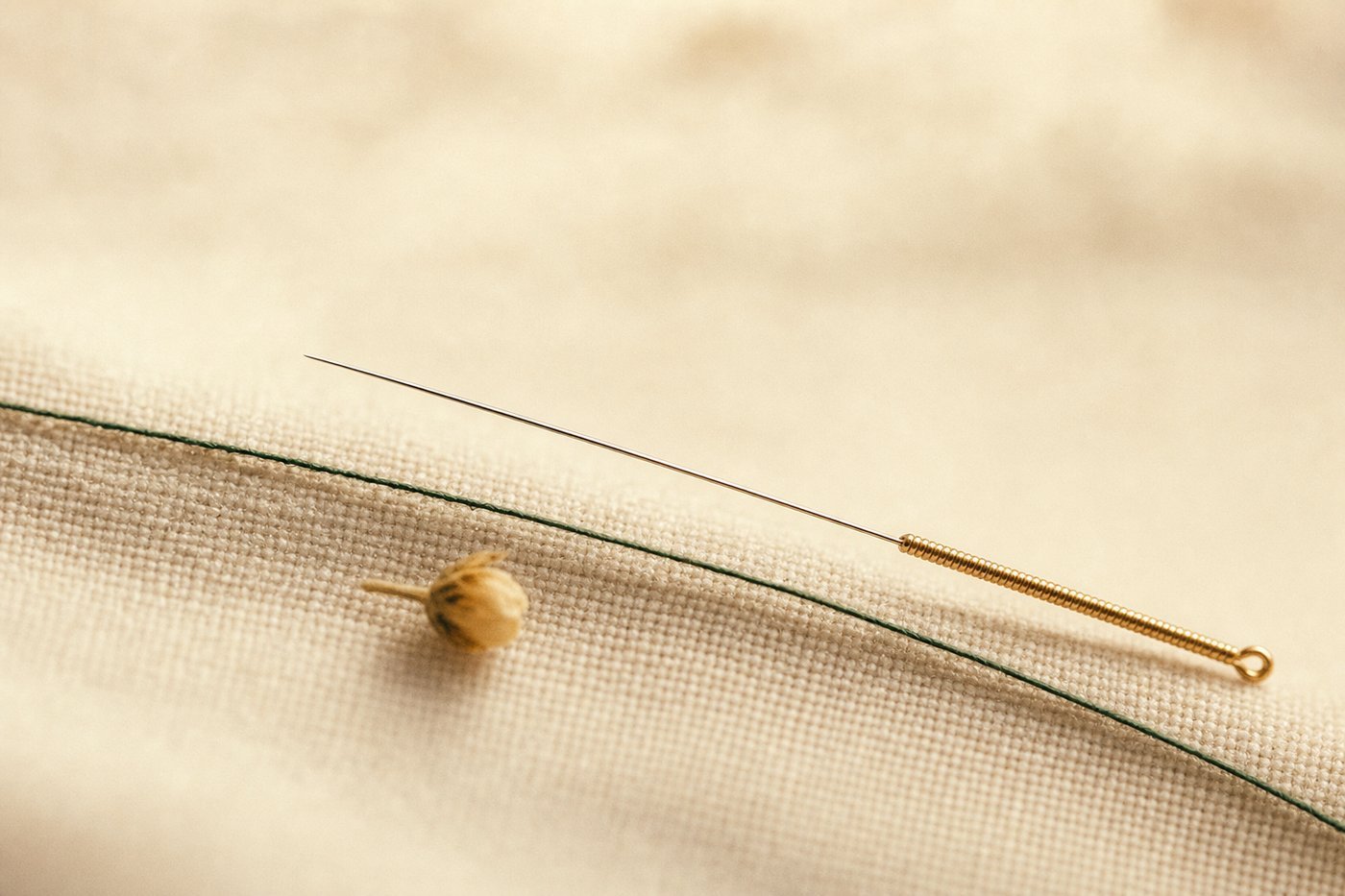
Traditional Chinese medicine uses a filiform needle. Solid, no channel through the middle, and the tip isn’t a cutting edge. How fine? Think in the same order of magnitude as a human hair.
So it doesn’t slice the skin open. It passes between tissue.
That fineness is also why the needle is flexible in the hand. Angle, depth and pressure all come down to the practitioner’s touch — the finer the needle, the more skill it asks for.
Needles are single-use and sterile: opened in front of you, discarded after. On a first visit, you’re completely within your rights to ask to watch the package come open.
At that thickness, the question stops being “will it hurt” and becomes “do you believe it won’t.”
【Image: SCALE comparison】

What does the “needle sensation” actually feel like?
The insertion itself is over quickly — closer to a light tap than anything else. What you’re really there to notice comes after.
TCM calls it de qi, “arrival of qi.” In the body it shows up as four distinct things:
- Dull ache — like the day-after-a-workout kind, but concentrated in one spot
- Fullness — a local sense of pressure, as though the area is being gently expanded from inside
- Heaviness — like a palm resting on that small patch of you
- Tingling — an occasional thread of current travelling along a line
Some people also notice warmth spreading through the area, or a sudden urge to yawn. This varies from person to person, and feeling none of it is perfectly normal too.
Dull, full, heavy, tingling — that isn’t pain turned down low. Those are four different things, not four settings on one dial.
If what you feel instead is sharp and persistent — a stabbing that doesn’t let up — that is not the needle sensation. Say so immediately. Your practitioner will adjust the angle or withdraw the needle. You can speak up at any point in the session. There’s nothing to tough out.
What’s different about getting acupuncture in BC?
This is the question a lot of people actually want to ask and don’t.
1. There are rules about who holds the needle. In British Columbia, acupuncture and traditional Chinese medicine are regulated health professions, and treatment must be performed by a registered acupuncturist (R.Ac). Acupuncture is an invasive procedure — that credential isn’t a formality.
2. Needles are single-use. Opened at the table, discarded after, never reused.
3. You hear the plan before anything happens. Which areas, how the session is structured, what you’re likely to feel — your practitioner walks you through it before picking up a needle. You can ask questions. You can also say no.
4. Ask for a receipt. Whether acupuncture is reimbursed depends entirely on your extended health plan, and no two plans read the same. Calling your insurer to confirm the details is the reliable route. Just mention at the front desk that you’d like a receipt.
Here, “I’d like to stop for a moment” is a complete sentence. Nothing has to come after it.
Six steps, door to door
1. Intake and paperwork. Medical history, current medications, allergies, whether you’re pregnant. Your practitioner will also ask about sleep, cold hands and feet, your cycle, and your mood.
2. Tongue and pulse. This is the TCM assessment: working out where your body is leaning right now.
3. The plan, out loud. Where the needles go, how the session runs — explained first. This is the moment to ask anything.
4. Lie down; needles in. Only the area being worked on is uncovered. The site is cleaned, and needles go in one at a time — not all at once.
5. Retention. Lights down, nothing required of you. How long depends on that day’s plan; you’re welcome to confirm when you book. If at any point you feel dizzy, light-headed, clammy, nauseated, or your vision starts to grey out, speak up right away — don’t wait it out. It isn’t unusual at a first appointment, and once you say something it’s handled immediately.
6. Needles out. Usually you barely register it. Sit for a minute before standing, have some warm water, walk out slowly.
How a full course of treatment gets designed is covered in Energy Acupuncture: Where Acupuncture Meets Energy Work.
【Image: ROOM treatment room】
What are you supposed to do while you’re lying there?
Needles in, afraid to move, no idea where to look. This is the part first-timers have no map for.
Your eyes. Closed is usually more comfortable. Open is fine too — pick a spot on the ceiling and let your gaze go soft.
Your phone. Silence it and put it in your bag. It will pick right back up the breath you just put down.
Headphones. Ask first if you’d like them. Two minutes in, you may find you’d rather have the quiet.
The bathroom. Go before you get on the table. If you genuinely need to go mid-session, just say so — don’t get up on your own, and never pull anything out yourself.
Wanting to stop. Say “I’d like to stop.” No explanation required.
Falling asleep. Happens. No need to be embarrassed.

Four things people get wrong, before and after
1. Don’t come hungry. Eat something one to two hours ahead. Wear loose clothing so your lower legs, shoulders and back are easy to reach.
2. Arrive a few minutes early and sit down long enough to catch your breath. Sprinting in and lying straight down means lying down tense.
3. Give your body the rest of the day. Baths, hot springs, swimming, saunas and heavy lifting all keep until tomorrow.
4. Don’t schedule anything demanding. People often feel sleepy afterward, so no long drives. A day or two of mild soreness is possible, and it varies from person to person.
Showering, exercise and alcohol are covered in Q4 below.
What do you have to tell your practitioner beforehand?
Acupuncture is an invasive procedure. None of the following automatically rules you out — but every one of them has to be raised before any needle goes in so the plan can be adjusted:
- Pregnancy, trying to conceive, or undergoing fertility treatment
- A bleeding disorder, low platelets, a tendency to bruise, or taking anticoagulant or antiplatelet medication
- Skin infection, broken skin, eczema or burns at the treatment site
- An implanted electronic device such as a pacemaker
- A current fever, or an active acute infection
- Diabetes, a weakened immune system, ongoing chemotherapy, or past lymph node removal (affecting that arm or leg)
- A history of fainting during needling or at the sight of blood, or fainting during a blood draw
Not sure whether something counts? Say it anyway. Deciding what matters is your practitioner’s job, not yours.
One more thing that belongs in plain language: for anything urgent or severe, see your family doctor, go to a walk-in clinic or the emergency department, and call 911 if the situation calls for it. TCM is a complement to everyday self-care — it does not replace necessary medical assessment or treatment.

Still nervous? Here’s what helps
First, say “I’m scared of needles” out loud. Once it’s said, your practitioner can slow the pace, use fewer needles, and stay away from the areas that worry you most. Saying it is what makes the adjustment possible.
Second, don’t book your first session for a day when you’re exhausted, hungry or rushing. The calmer your arrival, the easier it is to let go once you’re on the table.
Third, if what you’re really after is a stretch of quiet time with nothing to hurry toward, there’s a version of the session where the retention phase is taken more slowly. We call it Energy Acupuncture: acupuncture first, to open the meridians and support the movement of qi and blood, followed by energy work to guide the body toward relaxation.
It isn’t a premium tier sitting above regular acupuncture — it’s a different pace. It’s about the experience of the session. It isn’t aimed at any specific condition and doesn’t replace medical care, how it feels varies from person to person, and we adjust the arrangement to suit you.
【Image: AFTER a warm cup】
Common Questions
Q1: Should I come on an empty stomach for my first acupuncture appointment?
No — and we’d rather you didn’t. Eat something one to two hours beforehand, just not a heavy meal. Arriving hungry makes light-headedness and a racing heart more likely.
Q2: Will I bleed? Will it leave a mark?
Most of the time there is no bleeding once the needles come out. Occasionally a point releases a drop of blood or forms a small bruise, which usually fades within a few days. If a bruise keeps growing or the soreness gets worse, call the clinic.
Q3: How many needles are used, and how long do they stay in?
It varies from person to person. Your practitioner decides based on that day’s intake and TCM assessment, and retention time depends on the plan for that day — you’re welcome to confirm with us when you book. For a first visit, you can ask to start with fewer.
Q4: Can I shower or exercise on the same day as acupuncture?
A warm shower later in the day is fine — just not the moment you walk out. Save baths, hot springs, swimming and saunas for the next day. Skip intense workouts and heavy lifting that day; a walk is fine. It’s also better to leave alcohol for another day.
Q5: I’m too nervous to book. Can I just ask questions first?
Yes. Call 778-681-8886 and tell us what’s worrying you, or come in for a consultation and decide about needles after you’ve heard the plan. Saying “I’m scared of needles” out loud is what lets your practitioner adjust the pace.
From Dr. Judy
The question I hear most often in the treatment room is: “Doctor, is this going to hurt?”
My answer hasn’t changed. What acupuncture is looking for is that dull, full, heavy, tingling quality — not pain. You should feel it clearly, and it shouldn’t make you want to run.
Being nervous the first time is completely normal. What tends to shape the experience isn’t the needle at all; it’s lying down with your whole body already braced.
So eat something before you come. Get here a little early. Sit down and let your breathing settle. The rest of it, we take slowly, together.
You can just ask first
Still on the fence? You don’t have to book a treatment to talk to us — call 778-681-8886 and tell us what’s on your mind. We’ll talk it through on the phone: whether it suits you, and how a session would be arranged.
Sky TCM Acupuncture & Wellness
Continental Centre, Richmond
3779 Sexsmith Rd, Unit 1138, Richmond, BC V6X 3Y6
Phone 778-681-8886 (hours and treatment details — please confirm with us when you book)
Lead practitioner: Dr. Judy Chu, R.Ac — Registered Acupuncturist in British Columbia, with twenty years of clinical practice in Taiwan.
Further reading
- Energy Acupuncture: Where Acupuncture Meets Energy Work — how a combined session is designed
- The Metro Vancouver Clench: You Know How to Rest, You Just Can’t Stop — tight shoulders, poor sleep, and never quite switching off
This article is general health education. It is not medical advice and does not replace diagnosis or treatment by a physician. Acupuncture is an invasive procedure and must be assessed and performed by a registered acupuncturist (R.Ac) in British Columbia. If you are pregnant, have a bleeding disorder, take anticoagulant medication, or have a skin infection, please tell your practitioner before treatment. For urgent or serious conditions, seek medical care directly or call 911.