Looking for Richmond acupuncture done with restraint and skill? The moment a needle settles into place at Sky TCM, you’ll feel something quiet — a soft, spreading ache the classical texts call de qi (得气). It isn’t pain. It’s the body recognizing the needle. In our treatment room, Dr. Judy will often pause after each insertion, wait for that wave to pass, then gently adjust the angle. First-time visitors to our Richmond acupuncture room are often surprised — acupuncture isn’t about gritting your teeth. It’s the kind of release that happens when the body feels properly heard.
About Sky TCM — Richmond acupuncture clinic
Sky TCM Acupuncture Clinic is a Richmond practice built around acupuncture (针灸). We’re in Continental Centre, off Sexsmith Road. From your first assessment through every session afterward, you stay with Dr. Judy — no handoffs, no fragmented care. The treatment rooms are quiet and curtained, the lighting soft, and the pace is unhurried — so the de-qi response has time to settle. We work in Mandarin, Cantonese and English, so you can describe sensations in whatever language feels most natural.
We also offer herbal medicine, tuina and structural work — see our Richmond TCM clinic overview for the broader picture — but acupuncture is Sky’s centerline, and this page is specifically about how we approach it. If you’re trying to understand what R.Ac registration means in BC, see Richmond R.Ac — registered acupuncturist explained.
What we offer at our Richmond acupuncture clinic
Acupuncture is the spine of our Richmond practice. Everything else exists to support it and to extend what happens at the needle:
- Acupuncture (针灸) — pain, sleep, facial acupuncture, women’s health, digestion
- Tuina (推拿) — post-needling release for neck, shoulder and back
- Structural alignment — postural work that resets the body’s frame, so each needle point sits where it should
- Herbal medicine and food therapy — formulas chosen to extend the work between sessions
- Women’s and children’s care — fertility-prep acupuncture, postpartum recovery, pediatric tuina (pediatric Chinese massage)
- Energy chamber — a relaxation pod for post-treatment grounding
We don’t chase “instant cures.” We focus on making sure every needle lands exactly where it should.
How we needle — technique and session flow
The real difference in acupuncture isn’t whether needles go in. It’s how they go in. Here’s what actually happens in our Richmond acupuncture room:
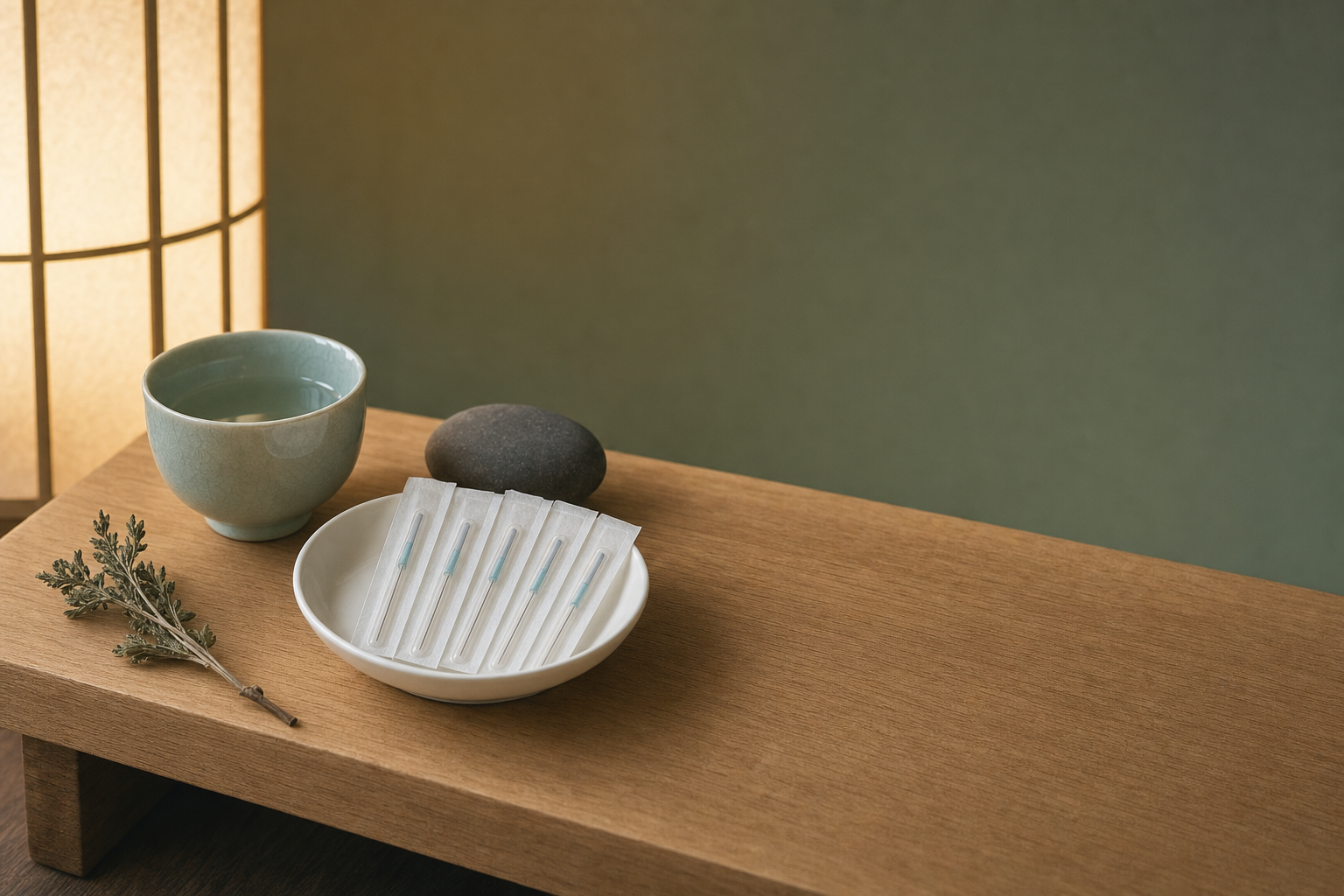
- Needle gauge and depth. We typically use very fine sterile single-use needles, 0.18mm to 0.30mm in diameter — finer than a strand of hair. Insertion depth ranges from roughly 5mm to 25mm, depending on the point, tissue layer, and your build (back-shu points sit deeper, facial points sit shallow). All needles are Health Canada-grade, opened from a fresh sealed packet at each visit, and disposed of after one application — never reused.
- De qi and manipulation. After insertion, Dr. Judy uses lifting, rotating and varying-speed techniques to elicit de qi (得气) — an aching, heavy or radiating sensation that varies from person to person. Her practice draws from classical lineages including fei jing zou qi (飞经走气, the classical qi-conducting needle technique) and the meridian-clock methods (子午流注, zi wu liu zhu), combining tonifying and dispersing approaches based on time of day, presentation, and constitution.
- Retention time. Needles are typically retained for 20 to 30 minutes — shorter (around 15 minutes) for acute pain, longer (up to 35 minutes) for deeper deficiency patterns. During retention, Dr. Judy checks in once or twice to read your colour, breath, and the persistence of the de-qi response.
- Adjunct modalities. Where appropriate, we add a TDP heat lamp (far-infrared warming therapy) to support meridian flow, or e-stim (electro-acupuncture) for nerve entrapment, Bell’s palsy, or sports injury recovery. We don’t stack modalities by default — the addition is based on what your body’s actually telling us in the room.
- Post-needling response. A small number of people feel drowsy in the 24 hours after a session, fall asleep earlier than usual, or notice mild bruising at the puncture sites. These are the body adjusting, not adverse reactions. After your first visit, you’ll get a short aftercare sheet.
These technique-level details are what we want our Richmond acupuncture practice to be known for — not speed, but precision.
Dr. Judy Chu — Twenty years of clinical practice [Pending CV verification by Dr. Judy]
Dr. Judy Chu (R.Ac) studied at Guangzhou University of Chinese Medicine (广州中医药大学) and has spent twenty years in clinical practice across mainland China, Taiwan and Canada. Her needling draws from classical lineages — fei jing zou qi (飞经走气, the classical qi-conducting needle technique), the meridian-clock methods (子午流注, zi wu liu zhu), and facial acupuncture for circulation and tonus. She likes to say, “It isn’t how many needles, it’s where each one lands.” In our treatment room, you’ll see her take the pulse again and look at the tongue again before each session — because the body is different today than it was last week, and last week’s plan doesn’t carry over unchecked.
Since landing in Richmond, Dr. Judy has paid close attention to how local Chinese-Canadian constitutions and the North American pace of life shape acupuncture work — cold-damp coastal climate, long indoor hours, sedentary work patterns, stress-driven sleep disturbance. She’s comfortable coordinating with family doctors, obstetricians, and physiotherapists where shared care makes sense. The clinic accepts direct billing from several extended health plans; we can confirm coverage when you book.
Visit our Richmond acupuncture clinic
3779 Sexsmith Rd, Unit 1138, Richmond BC V6X 3Y6
Continental Centre
778-681-8886
Daily 10AM – 6PM by appointment
A short walk from the Canada Line Aberdeen station, with free public parking in the Continental Centre lot downstairs.
Richmond acupuncture FAQs
Does acupuncture hurt?
The needles we use are very fine — 0.18mm to 0.30mm in diameter, finer than a strand of hair. Most people feel a soft, spreading ache rather than the sharp prick you’d associate with an injection. All needles are sterile, single-use, and disposed of after one application.
How long is a session?
First visits run about an hour, including consultation, pulse and tongue diagnosis, and treatment. Follow-up sessions are around 45 minutes. Needles are typically retained for 20 to 30 minutes, with Dr. Judy checking in during that time.
How many sessions until I feel a difference?
It depends on what you came in for. Acute pain often responds within three to five sessions. Longer-running concerns like sleep, cycles and digestion usually take a course of eight to twelve sessions to settle properly — in TCM, “regulation” follows its own rhythm, and qi, blood and organ-system patterns need a continuous window of time to reset rather than a single “fix.” After your third visit, you’ll get an honest read on how things are tracking. Individual response varies.
What kinds of issues do you treat with acupuncture?
The most common ones in our practice are neck, shoulder and back pain, migraines, sleep difficulty, anxiety, irregular cycles, fertility prep, postpartum recovery, Bell’s palsy, seasonal allergies and digestive complaints. A short evaluation is the best way to see if it’s a fit.
Can I have acupuncture during pregnancy? [Pending verification by Dr. Judy]
Yes, with care. Certain points are traditionally avoided during pregnancy — we avoid points including hegu (LI4), sanyinjiao (SP6) and jianjing (GB21) during pregnancy. Dr. Judy has substantial experience with pregnancy-related acupuncture — morning sickness, lower-back pain, breech-position support (with the understanding that individual response varies and successful turning isn’t guaranteed), and labour preparation. We typically begin pregnancy acupuncture after the first trimester (week 13 onwards), and ask to see your prenatal records before the first session. Please tell us your trimester and any prior pregnancy history before we start.
Book a Richmond acupuncture consultation
Curious whether acupuncture is right for what you’re working with? The simplest answer is a first-visit evaluation — Dr. Judy reads the pulse, looks at the tongue, listens to your history, and gives you a direct opinion on whether acupuncture fits, how many sessions a course should run, and whether herbal medicine or tuina belongs in the plan.
Dr. Judy Chu, R.Ac at Sky TCM
3779 Sexsmith Rd Unit 1138, Richmond BC V6X 3Y6 · 778-681-8886 · Daily 10AM–6PM
Book a first consultation · About Dr. Judy · Our treatments