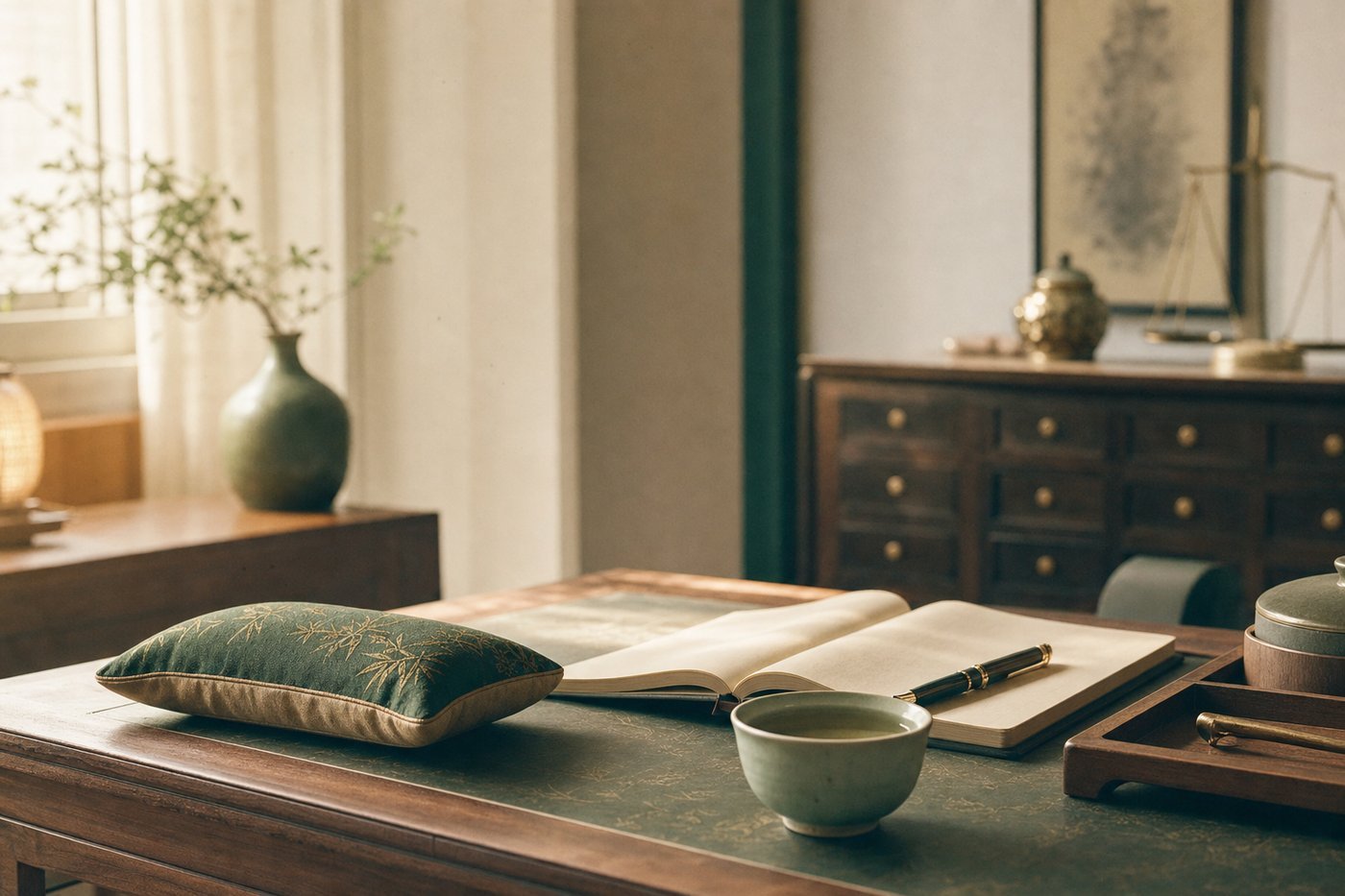
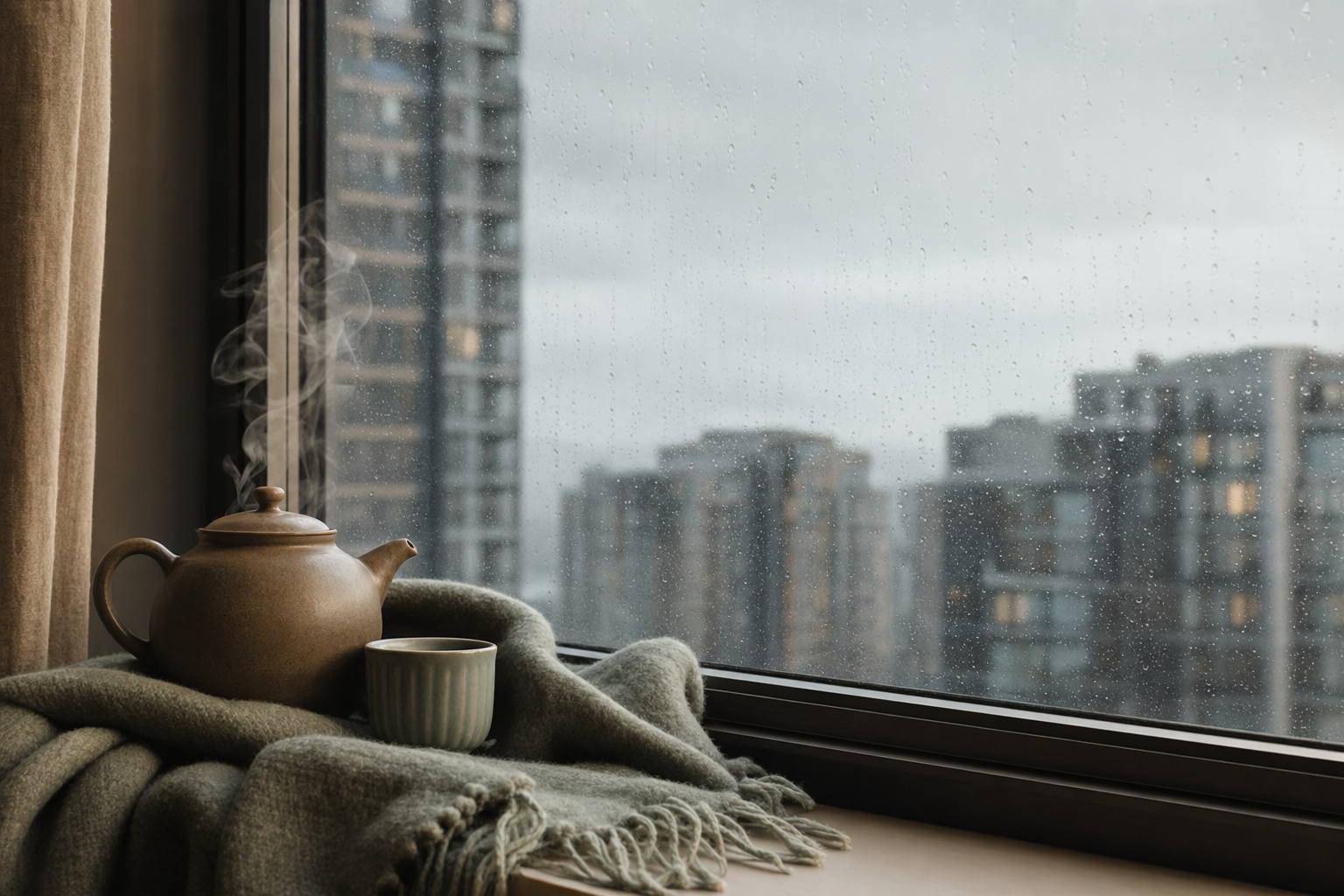
This is the most familiar picture we see when a woman comes in asking about Vancouver postpartum confinement care:
She was sitting in the consult room and held her right knee out for us to see. It looked completely fine from the outside — no redness, no swelling, no deformity. Her family doctor’s X-ray had come back, in her words, “as clean as a knee could be.” But every year starting in October, she said, that leg “knew” before the forecast did that the Vancouver rain was coming. First a chill rising from the back of the knee. Then the cold spreading down the calf. By December the whole leg felt heavy enough to drag.
She is 35. We asked her, “Where did you do your confinement?” She paused. “A condo in Burnaby. March. My mom had just landed, newly arrived and still navigating the English healthcare system, and the apartment was cold…” Symptoms that surface only in a woman’s thirties or forties, but whose root sits years back, in a hard 坐月子.
How Chinese medicine sees this
Chinese medicine has an old line: “After childbirth, every joint sits empty — wind, cold, and damp slip in easily.” Translated: after giving birth, a woman’s joints, pores, and channels are all open at once — every window in the house propped at the same time. If cold air, damp, or wind move in during this period, they do not stop at the skin. They follow the open pathways inward — into the joint capsules, into the lower abdomen, into the sacrum.
Once they are in, while you are young and your yang qi is full, you do not notice. The vitality of your twenties is a thick blanket pulled over everything underneath. Chinese medicine teaches that for women, kidney qi (肾气) begins to taper around the mid-thirties. The blanket thins year by year. And whatever was tucked under it begins to show through.
Vancouver is a particularly high-risk environment for damp-cold (寒湿) to settle in. There are three reasons. First, the rainy season is long — late October through April, most days are grey and wet, and humidity stays high. Second, the housing stock, especially older condos and townhouses, runs cool: wood floors, single-pane windows, no radiant heat. Third, immigrant mothers very often have less confinement support than would be ideal — mothers and mothers-in-law not on the same continent, professional confinement nannies out of budget, partners back at work within a week, and the local healthcare system still unfamiliar. Many mothers, in practice, do their own 坐月子.
The three together make a near-perfect environment for damp-cold to settle in. This is part of why a TCM approach to postpartum recovery often has to go a half-step further in Greater Vancouver than it would somewhere drier.
The main lines of Vancouver postpartum confinement care
When a woman comes to us with the picture we just described, the work is rarely a single technique. It runs along four lines at the same time, because a body that has been carrying damp-cold for years is not the kind of machine you fix one component at a time — warming the yang only holds if the qi and blood come up underneath it, and the cycle is the place where we watch whether the channel work is actually reaching the lower abdomen. The four lines are one net.
First, warm yang and resolve dampness (温阳化湿). This is the floor. We use moxibustion (艾灸) at Shenque (CV8), Mingmen (GV4), Guanyuan (CV4), and Zusanli (ST36) to gently rebuild the body’s “fire.” Moxa is gentle, continuous, and able to penetrate down to the joint capsules and the deep belly. This first stage usually runs across a meaningful stretch of weeks; it is not a one-visit project.
Second, open the channels and disperse cold. Damp-cold tends to sit inside the body as something congealed — like grease in a cold pipe. The work here is acupuncture, gua sha, and tuina (推拿), patient softening of those frozen places. Common areas are the knees, sacrum, neck and shoulders, and the lower abdomen where the uterus sits.
Third, build qi and blood and steady the root. Damp-cold could enter in the first place because qi and blood were low and the protective qi (正气) was thin. Driving the pathogens out without rebuilding the foundation just opens the door for the next round. This line runs underneath the others all the way through, not as a separate phase.
Fourth, regulate menstruation and women’s health. One of the most common adult-life expressions of “damp-cold from confinement” is menstrual: worsening period pain, light dark flow, longer cycles, difficulty conceiving. For most women in their thirties and forties, treating the after-effects of confinement and treating the cycle are one project. If conception is also on the table, the direction shifts toward nourishing the follicle and supporting endometrial thickness. (If this is the line that brought you here, you may also want to read our postpartum fertility prep cornerstone.)
A guest’s story
Ms. Lee, second-generation immigrant, 35. We told part of her story at the top. She had her first baby at 27. Confinement was in a 1980s-built Burnaby condo, in March, when it rained on nearly every day of that month. Her mother had just arrived, was not familiar with local ingredients, and the confinement meals came together unevenly. Her husband commuted to downtown and got home at 7 p.m. She remembers, “There were at least seven or eight nights that month when I walked from the bedroom to the kitchen in my pajamas to heat soup, on bare floors, in the cold.”
By her early thirties she had begun to notice: from October through April, the knee would feel a draft no one else could; a cold patch had settled in her lower back; her cycle had drifted from 28 days out to 35; and more than a year of trying for a second baby had not moved. She came to us in the spring of her 35th year — eight years after the confinement itself.
We did not promise a fix. We told her honestly: damp-cold that has been settled in for eight years does not move in a few sessions. We needed a full spring-through-winter to do real work. The plan was warming yang and opening channels in spring and summer (using the season’s natural yang to push cold outward) and tonifying qi and blood in fall and winter (so the wet season would not deepen the problem). On a later visit she said the leg-heaviness that used to arrive at the start of October had only shown up lightly by deep winter that year; her cycle was running with a steadier rhythm than before; and the fertility work continued.
[Case · pending verification by Dr. Judy]
What you can try at home first
None of the three things below replace the work we would do together. But while you are waiting for a first visit, or still deciding whether to come in, they reduce the amount of new damp-cold that gets in. The smaller the inflow, the less the inside team has to push outward.
Keep a thick pair of indoor shoes by the front door. Do not walk barefoot on the floor, even in summer. Cold enters from the feet, and Vancouver wood floors and tile in winter are genuinely cold. For a woman who already has confinement-related damp-cold, ten minutes barefoot and ten minutes in thick slippers are two completely different deposits in the body’s ledger.
One foot soak a week through the winter. Around 41 degrees Celsius, with a small handful of coarse salt and a few slices of ginger, for 15 minutes — long enough that your upper back feels a faint sweat. Skip the soak if you are running a fever, on the heavy days of your period, or after 10 p.m.
Don’t drink iced beverages all winter. Vancouver cafés serve cold-brew year-round, restaurants still bring ice water in January, and bubble tea is cold by default. For a woman with damp-cold in her history, “no ice, please” becomes the easiest, cheapest piece of self-care.
When to come in for Vancouver postpartum confinement care
In our practice, Vancouver postpartum confinement care tends to look something like this on the first visit: you describe a pattern that has been with you for years, and we map it back to the confinement it traces from. We suggest booking a consultation if any of these describe you:
- After age 30, you have become noticeably more sensitive to cold, wind, and rain — even if your family doctor finds no structural problem
- Your cycle has lengthened, the flow lightened, or period pain has worsened after 35
- A joint — especially knee, sacrum, neck and shoulder — reacts to weather changes, particularly at season transitions
- More than six months of trying for a baby without progress, after a confinement that did not go well
- You know your own 坐月子 was difficult, and want a structured catch-up round of care that addresses the root rather than the surface
Chinese medicine has a line about confinement-related issues: “Better to prevent before, but still treatable after.” Even if you are now 35, 40, or 50, what was tucked away during a difficult 坐月子 can still be coaxed back. The earlier the start, the shorter the path. A full spring-summer-fall-winter is usually the smallest meaningful unit of repair for this kind of catch-up Vancouver postpartum confinement care.
Dr. Judy Chu, R.Ac at Sky TCM
3779 Sexsmith Rd Unit 1138, Richmond BC · 778-681-8886 · Daily 10AM–6PM by appointment
Book a first consultation · About Dr. Judy · Our treatments